
Tusheti is one of the most isolated regions in Georgia. For centuries the only access was on foot or horseback over the Abano Pass at 2,850 metres — still today, the only road in is one of the highest drivable mountain passes in Europe and is closed by snow from October to May. Tushetian food developed under those conditions. The cuisine is built on what shepherds could produce in summer pastures and preserve for the long winter: sheep’s milk turned into guda cheese aged in sheepskin, leftover whey reduced to kalti curd, lamb and beef minced for khinkali, wheat and corn flour kneaded into bread.
There are almost no restaurants in Tusheti in the conventional sense. Omalo, the regional capital, has one wine bar and a handful of guesthouses with restaurants. Dartlo, Shenako, Diklo and the trekking-route villages of Girevi and Chesho have only guesthouse kitchens. The rule across the region is simple: eat where you sleep, and book full board. The food at a Tushetian guesthouse table — produced in small quantities for the people staying that night, from the family’s own dairy, garden and stores — is the most authentic version of any dish you will find.
This guide covers what to expect from Tushetian food, where to eat in Tusheti’s main villages, and the guesthouse kitchens that matter on the Atsunta Pass trek. For a full overview of Georgian food by region, see the main guide. For where to stay in Tusheti, see our accommodation guide.
Guda Cheese and Tushetian Cuisine: What You Will Be Eating
Tushetian cuisine is a dairy and meat tradition shaped by sheep farming. Guda cheese — gudis kveli in Georgian — is the regional signature. It is a salty hard cheese made from sheep’s or cow’s milk and aged inside an inverted sheepskin (a guda) that gives the cheese its name and its distinctive earthy, slightly funky flavour. Guda is registered on Georgia’s Intangible Cultural Heritage list. Thick slices appear on the table at every Tushetian meal, including breakfast.
Kalti is the other essential Tushetian dairy product, and the one most travellers will not have encountered elsewhere. It is made from the whey left over after producing guda cheese: shepherds heat the whey over a wood fire, stir it with a wooden spoon, drain it through cloth bags, and dry the resulting curd in the sun. Dried, salted, and stored in another sheepskin sack, kalti keeps for months. It tastes sharp, crumbly and tangy, and it forms the base of kotori — Tushetian khachapuri — and of khavitsi, the region’s answer to fondue.
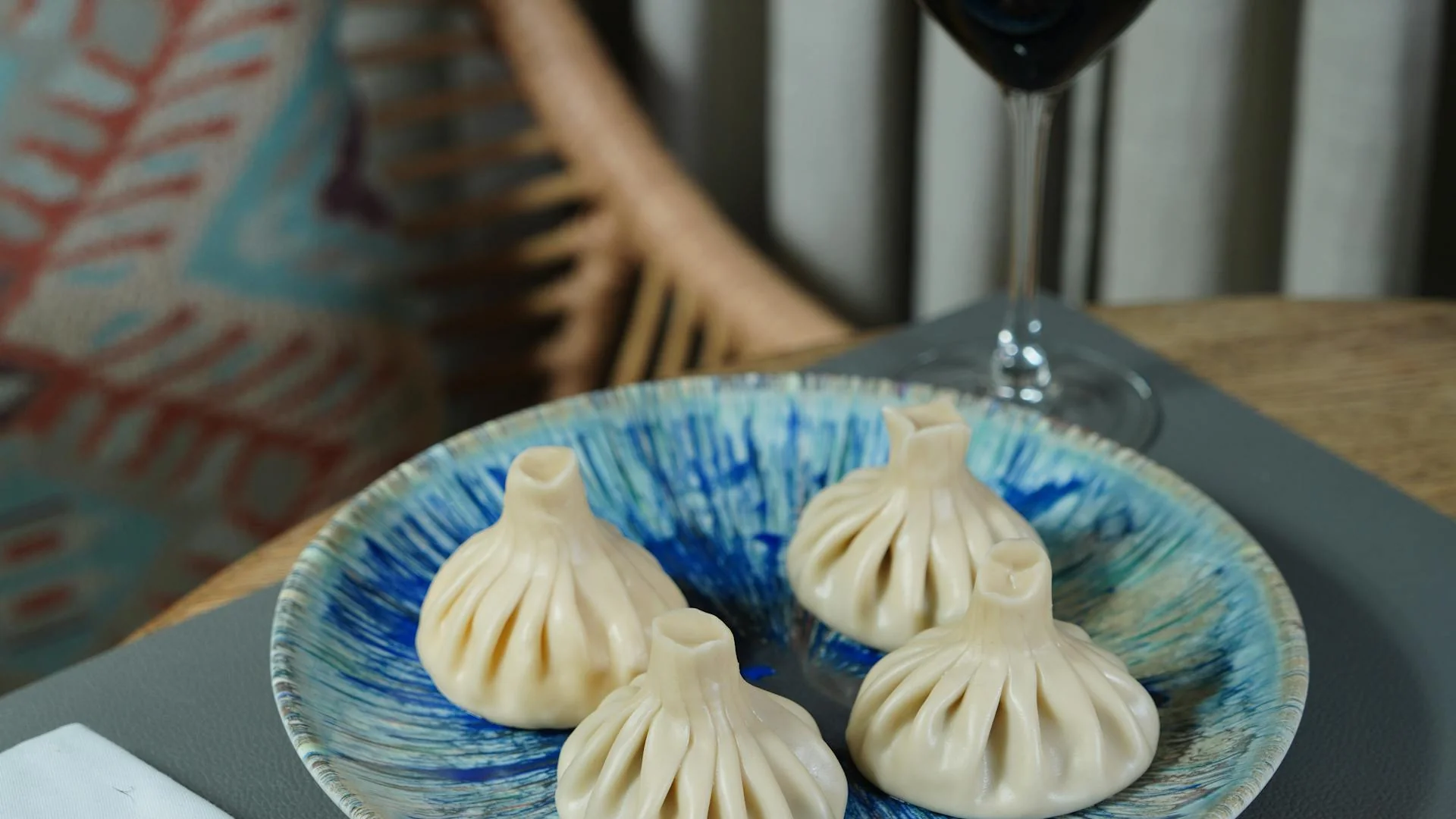
Tushetian khinkali deserves its own mention. The mountainous Pshavi-Tusheti region is widely considered the birthplace of khinkali, and the local version is distinct: thicker dough than the Tbilisi city style, filled with lamb or beef cut with a dagger rather than ground, seasoned only with cumin, onion and salt. No herbs, no pork (rare in the mountains). The flavour is cleaner and more meat-forward than what you get at Tsiskvili or any chain in Tbilisi.
Tushetian cooking is rarely seen on restaurant menus in Tbilisi. Gunda restaurant in Tbilisi serves kotori, and a handful of higher-end places do khavitsi as a seasonal special, but the full Tushetian repertoire — kotori, kalti, khavitsi, choban kaurma, aludi beer — is essentially only available in Tusheti itself.
| KHAVITSI — TUSHETIAN FONDUEA simple staple from a shepherd’s kitchen. Khavitsi is melted curd cheese (kalti, or any fresh sheep’s-milk curd as a substitute) blended with a generous amount of clarified butter or lard, cooked in a heavy skillet until smooth and stretchy. Served hot in the pan with torn pieces of shoti bread or kotori for dipping. Proportions are roughly two parts curd to one part butter, but every household varies. A pinch of salt at the end. Solidified leftover khavitsi can be sliced and carried as energy food on a hike — shepherds have done this for centuries. |
Omalo: Where to Eat in Tusheti’s Main Village
Omalo is the only village in Tusheti with anything resembling a choice of places to eat. The settlement is split into Lower Omalo (Kvemo Omalo) along the valley road and Upper Omalo (Zemo Omalo) on the ridge above, with the Keselo fortress towers between them.
Wine Bar O’Dila Tusheti
In Upper Omalo, O’Dila is the only true wine bar in Tusheti and the most consistently praised eating spot in the region on Tripadvisor. The setting is a garden with mismatched furniture, a multilingual book library, a guitar for whoever wants to play it, and tables under the open sky. The wine list is hand-selected from small Kakheti producers — most of it qvevri-fermented amber and red. The food is limited but well-handled: cheese plates with local guda, snack-sized kotori, and seasonal salads. It is the right place for a slow lunch after a hike or an early evening drink before dinner at your guesthouse.
Open in summer only, roughly June through September. Cash only.
| Location | Upper Omalo (Zemo Omalo), near Keselo towers |
| Vibe | Wine bar with garden seating, library, guitar, relaxed afternoon spot |
| Price | 25–45 GEL ($9–16) per person with a glass of wine |
| Find it | Google Maps: Wine Bar O’Dila Tusheti | walk-in, summer only |
Guesthouse Lasharai
Lasharai opened in 2015 in Upper Omalo and is one of the few modern stone-built guesthouses in Tusheti. Elene and her family run it, and the in-house restaurant is open to non-guests for dinner if booked the same day. The table looks across to the Keselo fortress towers. The dinner spread is a full Tushetian set: kotori, Tushetian khinkali, khavitsi served hot in the pan, guda cheese, fresh salad from the garden, homemade chacha and fruit wines. Several visitors describe the khinkali here as the best they had during their entire trip in Georgia.
Dinner is not included in the room rate — it is charged separately at around 25–35 GEL per person. Book the meal when you arrive in the afternoon; the kitchen cooks to order.
| Location | Upper Omalo, 55m from village centre |
| Vibe | Modern stone guesthouse with restaurant, Keselo views, English-speaking family |
| Price | 25–35 GEL ($9–13) per person for dinner |
| Find it | Booking.com: Guesthouse Lasharai | book dinner on arrival |
Tusheti National Park Visitor Centre Restaurant
Near the entrance to Omalo, the Tusheti Protected Areas Visitor Centre runs a small restaurant alongside its seven guest rooms. The kitchen serves Georgian and Tushetian dishes — khinkali, kotori, salads, grilled meat — and the building has a scenic overlook from a short walk away. The food is reliable rather than memorable, but the restaurant is open to walk-in diners and the setting is convenient if you have just arrived from the Abano Pass and your guesthouse host is not yet ready with dinner.
| Location | Near Omalo, at the Tusheti Protected Areas Visitor Centre |
| Vibe | Official park-run restaurant, useful first-night option |
| Price | 20–35 GEL ($7–13) per person |
| Find it | Google Maps: Tusheti Protected Areas Visitor Centre | walk-in |
Dartlo and the Pirikiti Valley
Dartlo is the photogenic village of Tusheti — a cluster of slate-roofed stone houses and defensive towers at 1,850 metres in the Pirikiti Valley, about 15km and a rough hour’s drive north-west of Omalo. There are no restaurants. The two guesthouses below both serve full board and represent the better food in the village.
Qeto’s Guesthouse
Qeto’s is one of the better-known names in Dartlo for travellers focused on food. The house serves aludi — Tushetian fermented barley beer brewed with wild hops — by the glass season-round, which is unusual; most households only make aludi for religious festivals. Dinner is a full Tushetian table: kotori finished with clarified butter, khinkali, khavitsi, garden salads, and chacha if you want it. The atmosphere is family rather than hospitality-industry; Qeto and her family eat at the same time as guests.
Solar power means hot water depends on the weather. Cash only. The road from Omalo to Dartlo follows a steep ridge and takes an hour by 4WD or about three hours on foot via the 11km trail.
| Location | Dartlo village, Pirikiti Valley |
| Vibe | Family-run guesthouse, aludi beer by the glass, full Tushetian dinner |
| Price | Full board 70–90 GEL ($25–33) per person per night |
| Find it | Ask in Dartlo or book via Tusheti Friends Association |
Guesthouse Pirimze and Samtsikhe
Two adjacent stone guesthouses in central Dartlo, both rated 8.6 on Booking. Pirimze has a garden, a bar and an on-site restaurant; Samtsikhe is slightly larger with barbecue facilities and a 24-hour front desk. Either is a reasonable choice if Qeto’s is full. The food is consistent across both: Tushetian khinkali, kotori, soup, garden vegetables, occasionally a slow-cooked lamb dish if there is one in the pot. Both serve dinner to non-guests on request when capacity allows.
| Location | Dartlo village centre |
| Vibe | Stone guesthouses, restaurants, full Tushetian dinner, bar |
| Price | Full board 60–80 GEL ($22–29) per person per night |
| Find it | Booking.com: Guesthouse Pirimze / Samtsikhe Dartlo |
Shenako and Diklo: Eating in the Eastern Villages
Shenako and Diklo are in the Chaghma branch of Tusheti, east of Omalo and close to the Russian (Dagestani) border. Shenako has a 19th-century Orthodox church and is the only village in Tusheti on the electricity grid. Diklo, a short hike further east, is the last settlement before the border.
Old Tusheti Guesthouse and Cafe (Shenako)
A traditional wooden-balcony guesthouse in the centre of Shenako with a small outdoor cafe in the courtyard that serves passing trekkers and day-trippers as well as overnight guests. The host family produces their own dairy and honey, and grows the vegetables that appear on the dinner table. The kotori here is among the better versions in the eastern villages — properly pan-fried, brushed with clarified Tushetian butter, served hot.
| Location | Shenako village centre |
| Vibe | Traditional wooden guesthouse with outdoor cafe, own dairy and honey, kotori standout |
| Price | Full board 60–80 GEL ($22–29) per person per night |
| Find it | Tusheti Friends Association directory | walk-in for cafe lunch |
Family Hotel Diklo (Nino Sekhniaidze)
Diklo Family Hotel is 14km from Omalo at the very eastern edge of Tusheti — the last guesthouse before the Russian border. It is run by Nino Sekhniaidze, who offers culinary master classes on request: the kitchen will walk visitors through making kotori from scratch, including kneading the unleavened dough and grinding kalti for the filling. The full Tushetian dinner spread follows, eaten on a wooden balcony with views over the Chaghmi gorge.
| Location | Diklo village, 14km east of Omalo |
| Vibe | Family-run, traditional architecture, culinary master classes, balcony with gorge views |
| Price | Full board 70–90 GEL ($25–33) per person; cooking class extra |
| Find it | Tusheti Protected Landscape directory | book ahead in summer |
Guesthouse Kitchens on the Atsunta Pass Trek
The classic four-to-five day trek from Tusheti to Khevsureti crosses the Atsunta Pass at 3,431 metres, the highest non-technical pass on the Caucasus crossing. The route runs Omalo → Dartlo → Parsma → Girevi → Atsunta Pass → Mutso. Girevi is the last village before the pass and the last place to eat a hot dinner for two days. See our full guide to the Omalo to Shatili trek for route details, distances, and what to pack. Guesthouse food along this route is the most authentic Tushetian cooking available to visitors, produced in small quantities from the family’s own stores.
Guesthouse Nakudurta (Girevi)
Nakudurta sits at the head of the Pirikiti Valley in Girevi, 11km past Dartlo and the last guesthouse before Atsunta. Visitors who have crossed the pass to or from Khevsureti rate it consistently for the dinner: veal in a spicy tomato-based sauce, pancakes for breakfast, kotori on demand, packed lunches with kubdari-style stuffed bread for the trail. The host packs trekkers a thermos of beqkondari tea (Tushetian mountain herb tea) without being asked. Four rooms, shared bathroom, simple but warm. Cash only.
| Location | Girevi village, end of the Pirikiti Valley, 11km past Dartlo |
| Vibe | Last guesthouse before Atsunta Pass, family-run, trail-food specialists |
| Price | Full board 60–80 GEL ($22–29) per person per night |
| Find it | Booking.com: Guesthouse Nakudurta | book ahead, confirm dates by phone |
| TREKKING FOOD NOTEIf you are trekking the Atsunta Pass route, ask your guesthouse host the night before whether they can pack kotori, hard-boiled eggs, and a thermos of beqkondari tea for the trail. Most will. A piece of fresh kotori brushed with clarified butter holds up better than any sandwich on a long climb. Between Girevi and Mutso there is no food and no village for roughly two days — pack accordingly. |
Tusheti Food Dictionary
- Kotori: the signature dish — a thin, pancake-like khachapuri filled with aged kalti curd and salt-free cheese, pan-fried on a skillet and brushed with clarified butter.
- Tushetian khinkali: thicker-skinned dumplings filled with hand-chopped lamb or beef, onion, and cumin. No herbs, no pork.
- Khavitsi (or datkhuri): Tushetian fondue — kalti curd melted with clarified butter until smooth, served in the pan with bread for dipping.
- Guda cheese (gudis kveli): salty hard cheese aged in inverted sheepskin. Earthy and slightly funky. On the table at every meal.
- Kalti: aged curd cheese made from leftover whey, dried and salted. Sharp, crumbly, tangy. The base of kotori and khavitsi.
- Gordila: boiled bread — wheat or corn flour dough cut into cubes and simmered. Served as a starch alongside meat dishes.
- Choban kaurma: shepherd’s pit-cooked lamb — diced lamb placed inside a guda sheepskin, buried in embers and slow-cooked for eight hours.
- Aludi: Tushetian homemade beer brewed from mountain barley and wild hops. Lightly fermented, almost no alcohol, slightly fizzy.
- Beqkondari chai: mountain herb tea made from dried savory and other wild herbs. Drink it hot at any cafe on the Abano Pass drive.
Drinks in Tusheti: Aludi, Chacha and Mountain Herb Tea
Wine is not made in Tusheti — the altitude is too high for vines. What guesthouses pour instead is chacha (grape brandy brought up from the Kakheti valley below), homemade fruit wines from the previous summer, and in some households aludi, the low-alcohol fermented barley drink usually reserved for religious occasions.
Tushetian table protocol follows the wider Georgian supra tradition: the host pours, guests drink when toasted to, and the first pour should be accepted unless you have a clear medical reason. Saying “gaumarjos” (cheers, literally “victory to you”) is the standard response. If you cannot drink at all, make this clear before the bottle appears — Tushetian hosts are gracious about it, but mid-meal refusal can read as cold.
For non-alcoholic options, beqkondari chai is the regional speciality — a herb tea brewed from dried savory and other mountain plants, served strong and hot. In Shenako, Asmati Kurdgheladze sells dried beqkondari and other wild herbs by the bag if you want to take some home.
Practical Notes
- Cash only across all of Tusheti. There are no ATMs in Omalo, Dartlo, Shenako or Diklo. Withdraw GEL in Telavi or Akhmeta before driving the Abano Pass.
- The Abano Pass road is open from early June to mid-October only. July, August and the first half of September are peak; guesthouses fill up and same-day booking gets unreliable.
- Electricity in Tusheti is solar except in Shenako, which is on the grid. Hot water depends on the weather.
- The drive from Tbilisi to Omalo via Abano Pass takes 6–8 hours and requires a 4WD. Many rental companies prohibit driving this road — use a private driver or a shared taxi from Alvani.
- For trekkers crossing the Atsunta Pass to Khevsureti, the last guesthouse before the pass is in Girevi; the next hot meal after that is at Mutso, two days away. Pack accordingly. See the Omalo to Shatili trek guide for the full route.
Sources
- wander-lush.org — Tusheti travel guide and 22 things to know
- wander-lush.org — Dartlo village guide
- redfedoradiary.com — Tushetian cuisine: 7 traditional foods and drinks
- tusheti.travel — Tushuri Kotori (Tushetian khachapuri)
- georgia.travel — Tushetian khachapuri and regional food
- tushetiland.ge — Tushetian cuisine
- tushetipl.ge — Tusheti Protected Landscape accommodation directory
- apa.gov.ge — Tusheti Protected Areas guesthouse list
- tripadvisor.com — Wine Bar O’Dila Tusheti reviews
- booking.com — Guesthouse Lasharai, Guesthouse Nakudurta reviews
- nlinemedia.co.uk — Tushetian flavours
- caucasus-trekking.com — Tusheti region trekking guide
authenticgeorgia.guide | Food Guides